
Developing a Talent Strategy
Most organizations – private, public or not-for-profit – have a strategy and business plan for executing, monitoring and achieving their goals. Success is tracked and monitored through such metrics as profit, program delivery, quality improvement or client satisfaction.
If you asked those same organizations if they had a talent strategy that is delivering value, however, the answers may vary widely. In a 2018 McKinsey study, only 5 percent of organizations surveyed felt their talent management had been very effective at improving company performance. We saw the impact of this through COVID across many sectors and the following years have been incredibly challenging. Yet numerous studies – including those by McKinsey – continue to that show that organizations that focus on talent have significantly higher performance and outcomes.
Over my years in consulting, board and internal HR work, I have developed a position that I hold strongly: “We should never abdicate responsibility for having the best possible talent within our organization to meet our goals.”
When I say abdicate, I think of situations where a leader, team or organization appears to act as if they have no control over a talent issue:
There just aren’t any people out there in the market willing to do this work;
You can’t fire or performance manage them because they are in the union;
We can’t keep people because other employers are paying more;
The education system isn’t producing enough of the right people;
Our HR systems don’t provide that data.
Jim Clemmer, a well-known Canadian management consultant would refer to this kind of talk as “living on or below the line.” It’s a place where people sit in indecision, waiting for something to happen, or wallow in pessimism. This is not a place for real leaders, HR professionals, organizations, governments, boards or communities who are truly committed to succeed.
The development of a talent strategy requires intention and discipline to inform and prioritize decisions about scarce resources – money, time, people, technology, and executive and board focus. In my work in both private and public sector, my teams and I developed a model to guide this process through to multi-year plans:
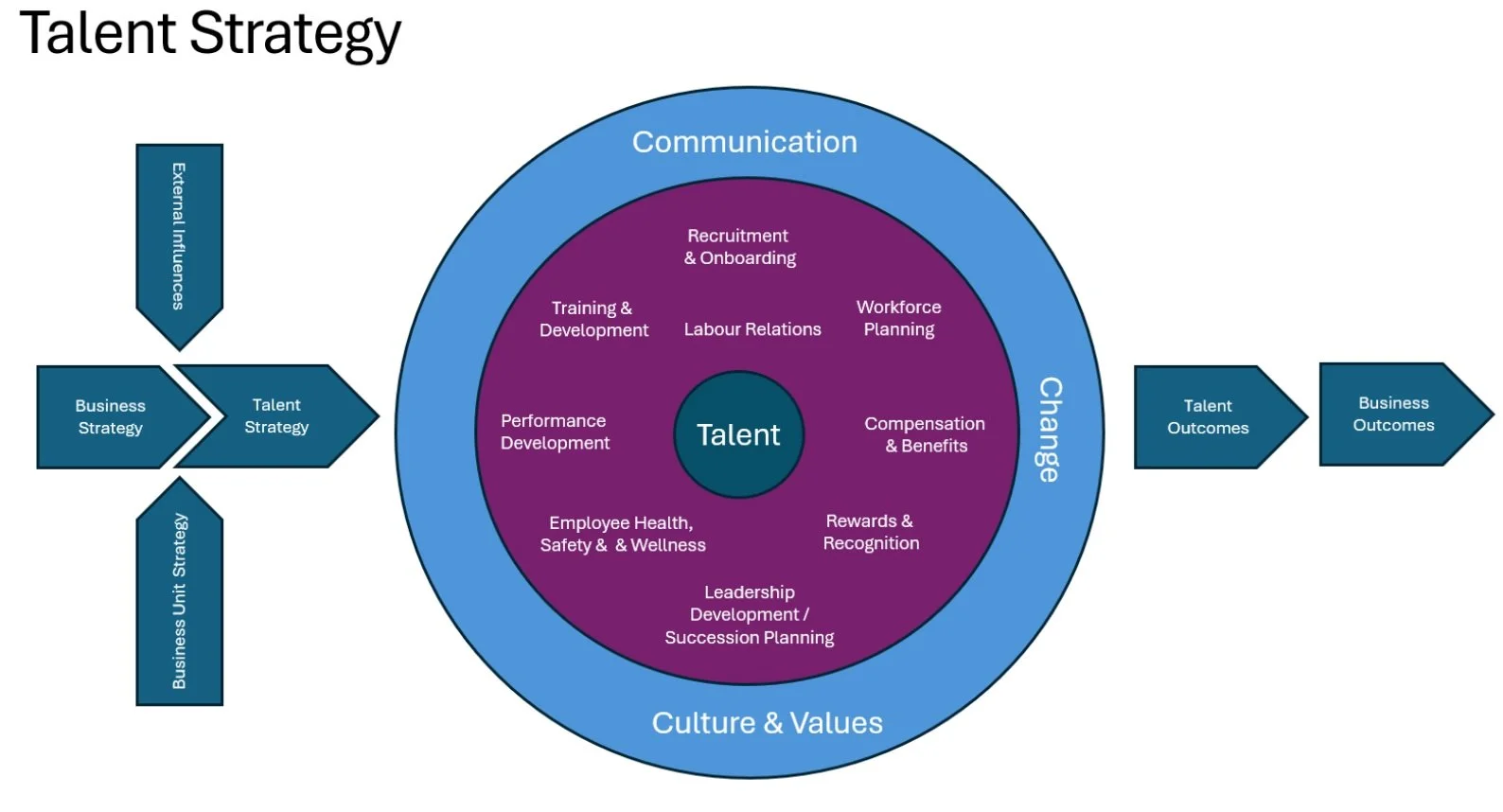
Facilitated planning with models like this help align people investments with organizational strategy. It supports inquiry into the internal and external factors affecting talent. It enables ‘what-if’ scenarios and risk assessment. It highlights what data is required to inform decisions. It helps in making strategic choices on talent investments, how to measure progress and when to revamp as required.
Here’s how the model works in practice:
Starting on the left, discussion begins with the business (or organizational) strategy to set the context. Information is also gathered to understand the external influences that could impact talent (e.g. competition for skills, changing technology). This is also the time to understand any talent needs that are unique to a specific business unit or department to achieve their goals (e.g. to support new product development or address cyber risk).
This front-end analysis leads to an initial Talent Strategy. It is a hypothesis and living document where you can revisit assumptions and adapt as new information becomes available. At its core – it is a statement about what people, skills and capabilities and performance are required to achieve the business strategy.
The wheel in the middle is where the Talent Strategy comes to life - and where HR delivers value. The central focus is supporting Talent – the people employed or contracted by the organization to bring the right skills and experience to deliver on the strategy.
At this stage of the discussion, I often like to lead with the question: “On a scale of 1-10, how would you rate your current team on their ability to deliver on the strategy and hit your year-end targets?”
The answer is rarely 0 or 10. It is somewhere in the middle. But once a leader or team grounds on their assessment, the focus then turns to “why do you feel this way” and “what gaps should we focus on” to support teams to get from 6 to 8, 7 to 9 and so on. It also allows leaders and teams to articulate and explore what they may already be feeling in their gut but hasn’t yet been surfaced.
I remember one leader admitted their fear that they didn’t have the right talent to achieve that year’s deliverables. Up to that point, they either hadn’t realized or openly acknowledged their concern. However, their honesty enabled an immediate deep dive into what skills were missing, and an action plan to recruit, contract or train those skills asap.
These conversations around talent readiness lead to strategic choices on which people and culture activities to prioritize. And choosing is critical here, because HR teams and leaders rarely have the capacity to do it all. As one of my former CEOs liked to say, “if everything is important, then nothing is important.”
Once priorities are set, key performance indicators (KPIs) and benchmarks can be set to measure performance against goals. These are the Outcomes at the right side of the model. The premise is that, if you are achieving the talent outcomes, they should be contributing to helping you achieve the business outcomes.
In my last role, we developed a People Scorecard with nine key metrics reviewed quarterly by the HR Team, Senior Leadership and Board. Our belief was that if we delivered on the people outcomes, then patient care, quality, safety and wait times should improve. That provided incredible focus and alignment on how the right people, culture and work environment contributes to the health, safety and wellness of everyone in our community.
If you are interested in exploring how this approach could help your organization, I would be happy to chat.
References:
Winning with your talent-management strategy, McKinsey & Company, August 2018.
For the L of It: Living and Leading Above the Line, Jim Clemmer, December 13, 2023.
Recommended Listening: People Get Ready. Curtis Mayfield wrote and recorded this classic song with the Impressions in 1965. It soon became an anthem for civil rights and remains one of the greatest songs ever written. It has been covered by everyone from Bob Marley and Bob Dylan to Rod Stewart & Jeff Beck.